| Client | AJIN ELECTRONIC COMPONENTS CO., LTD.
|
| Scope of Work | 3D Printing ,Silicone AM Mold
|
| Lead Time | 1 week
|
| Completion Date | Apr 2025 |
| Project Timeline | 3D Printing - AM Mold 3D Modeling - AM Mold production
|
Background
적층제조를 이용한 제품 제조 방식에 대한 시장의 관심은 2010년대 들어 급속히 커졌습니다. 과거에는 CNC 가공이나 주형 제작이 담당하던 영역을, 적층제조가 점차 대체할 수 있으리라는 기대가 형성되었고, 이후 기술 발전과 함께 금속 출력 방식까지 등장하면서 그 가능성은 더욱 넓어졌습니다. 그러나 실제 산업 현장에서는 여전히 소재 대응성과 품질 안정성의 문제가 크게 작용했고, 원재료를 직접 가공하는 기존 방식 역시 강한 경쟁력을 유지하고 있었습니다.
이 가운데 SLS 방식은 적층제조가 기능성 부품 영역으로 확장될 수 있는 중요한 가능성을 보여준 기술이었습니다. 하지만 특유의 거친 표면 특성으로 인해, 기밀성이나 정밀한 조립성이 요구되는 산업용 부품에 적용하는 데에는 분명한 한계가 있었습니다. 이후 이를 보완한 MJF 방식이 등장하면서, 보다 높은 밀도와 균일한 표면 품질을 확보할 수 있게 되었고, 최근에는 국내외 주요 제조기업을 중심으로 실무 적용이 점차 보편화되고 있습니다.
그럼에도 불구하고 적층제조는 여전히 장비 도입 비용이 높고, 실무 경험의 축적과 공유가 충분하지 않은 영역이었습니다. 특히 어떤 출력 방식이 어떤 목적에 적합한지에 대한 이해가 부족할 경우, 개발과 제조 과정에서 반복적인 실패나 불필요한 비용이 발생하기 쉬웠습니다. 결국 적층제조를 실제 산업 부품에 적용하기 위해서는, 단순히 장비를 다루는 수준을 넘어 각 출력 기법이 지닌 재질적 특성과 기구적 작용을 정확히 이해하고, 후가공과 보완 부품까지 함께 설계할 수 있는 엔지니어링 역량이 필요했습니다.
아진전자 사례는 바로 그런 지점에서 의미를 갖습니다. 본 작업은 장치가 요구하는 성능과 사용 환경에 맞추어 적절한 적층제조 기법을 선택하고, 여기에 후가공과 실리콘 부자재 제작까지 연계하여, 국내 주요 제조기업 중 하나인 아진전자(구 대우전자) 의 과제를 해결한 사례였습니다. 다시 말해, 적층제조가 단순한 시제품 제작을 넘어 실제 산업 현장에서 요구되는 기능성과 조립 신뢰성을 갖춘 부품 제작 방식으로 활용될 수 있음을 보여준 기록이라 할 수 있습니다.
Project Features
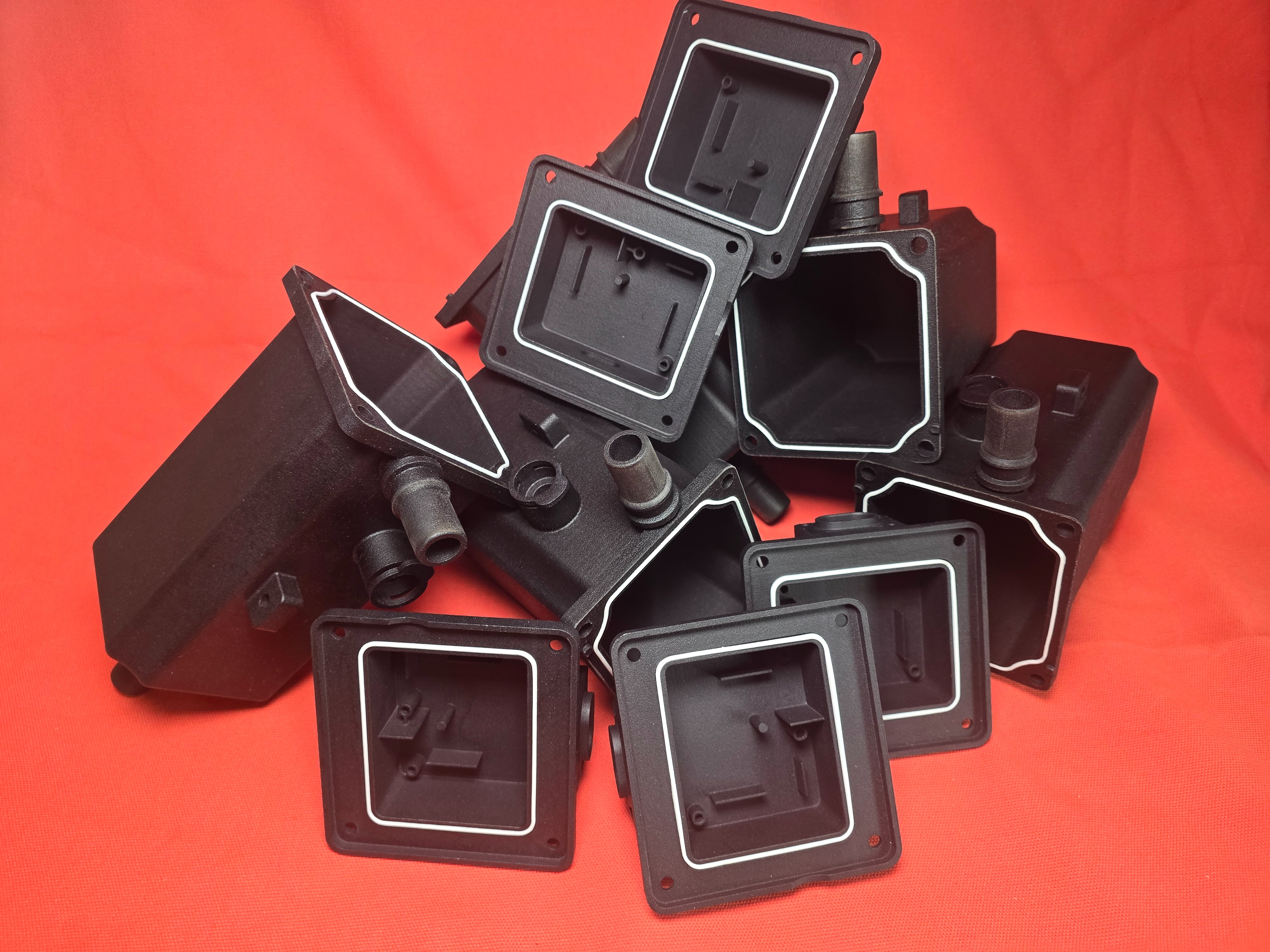
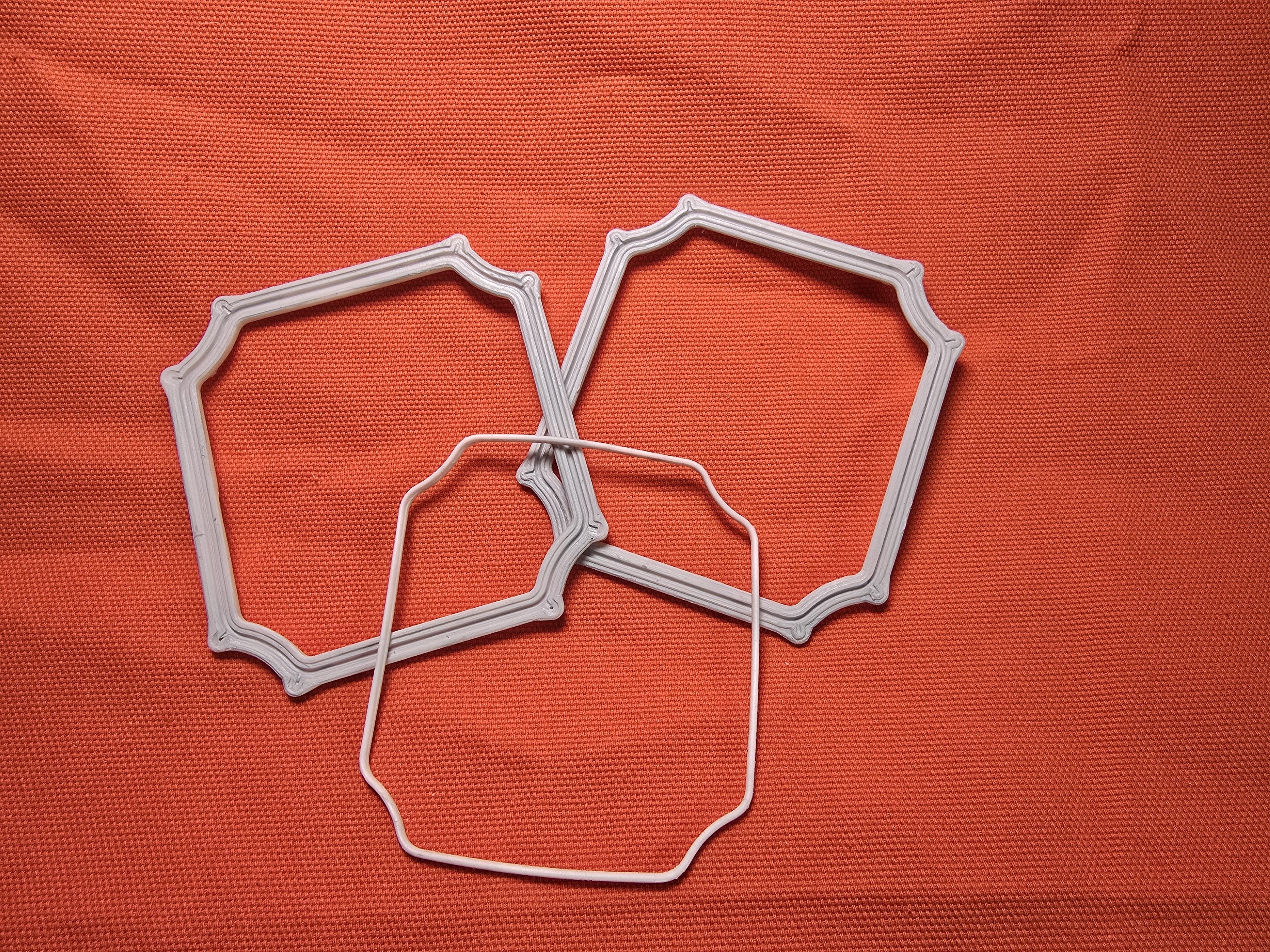
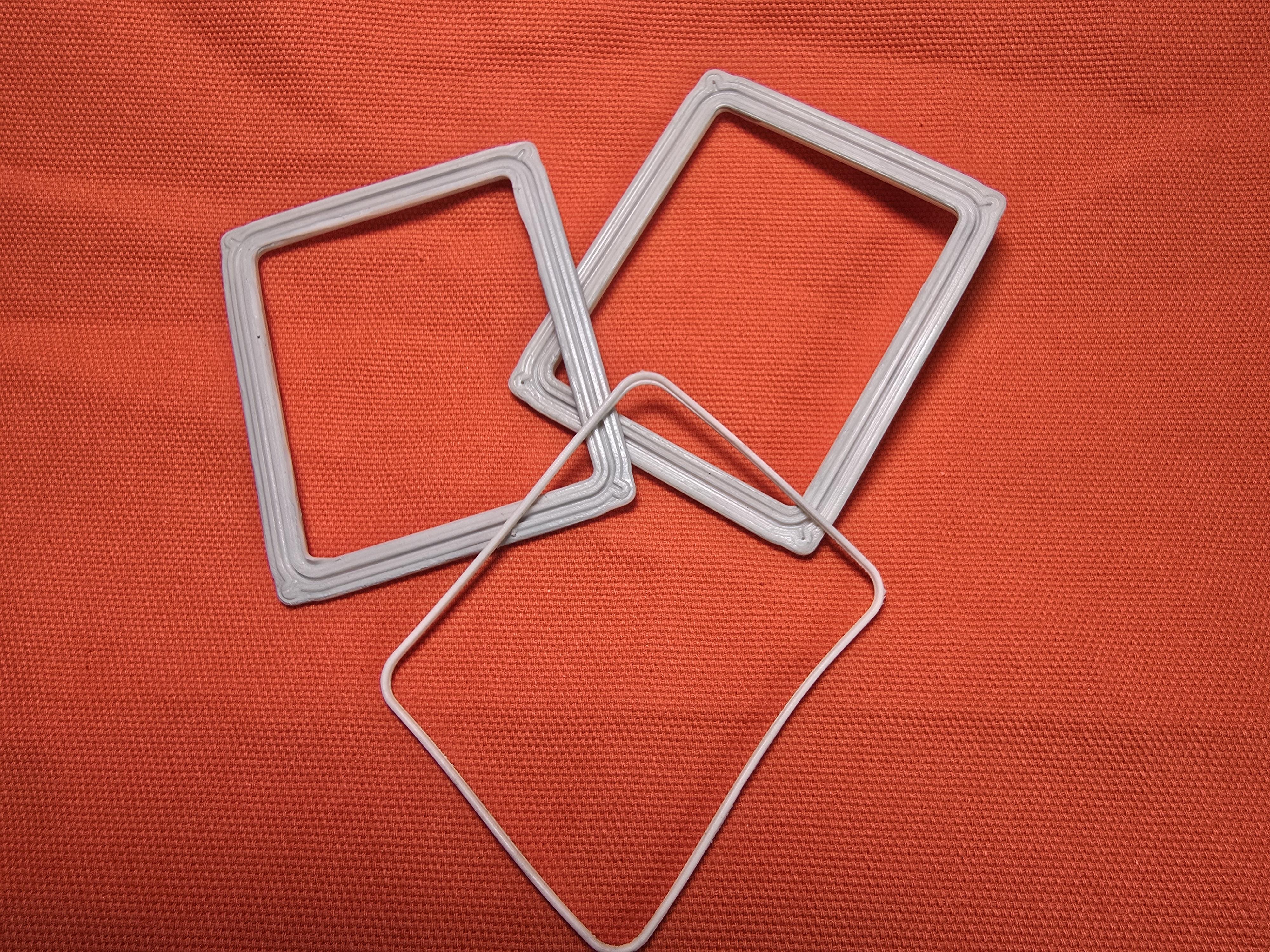
5bar 이상(약 0.5MPa급)의 공기압 환경에서 기밀 유지가 요구되는 실린더와 실리콘 가스켓의 제작 사례입니다.
본 작업은 단순한 형상 구현이 아니라, 실제 압력 유지 성능과 조립 신뢰성을 동시에 확보해야 하는 기능성 부품으로서 설계 및 제작되었습니다.
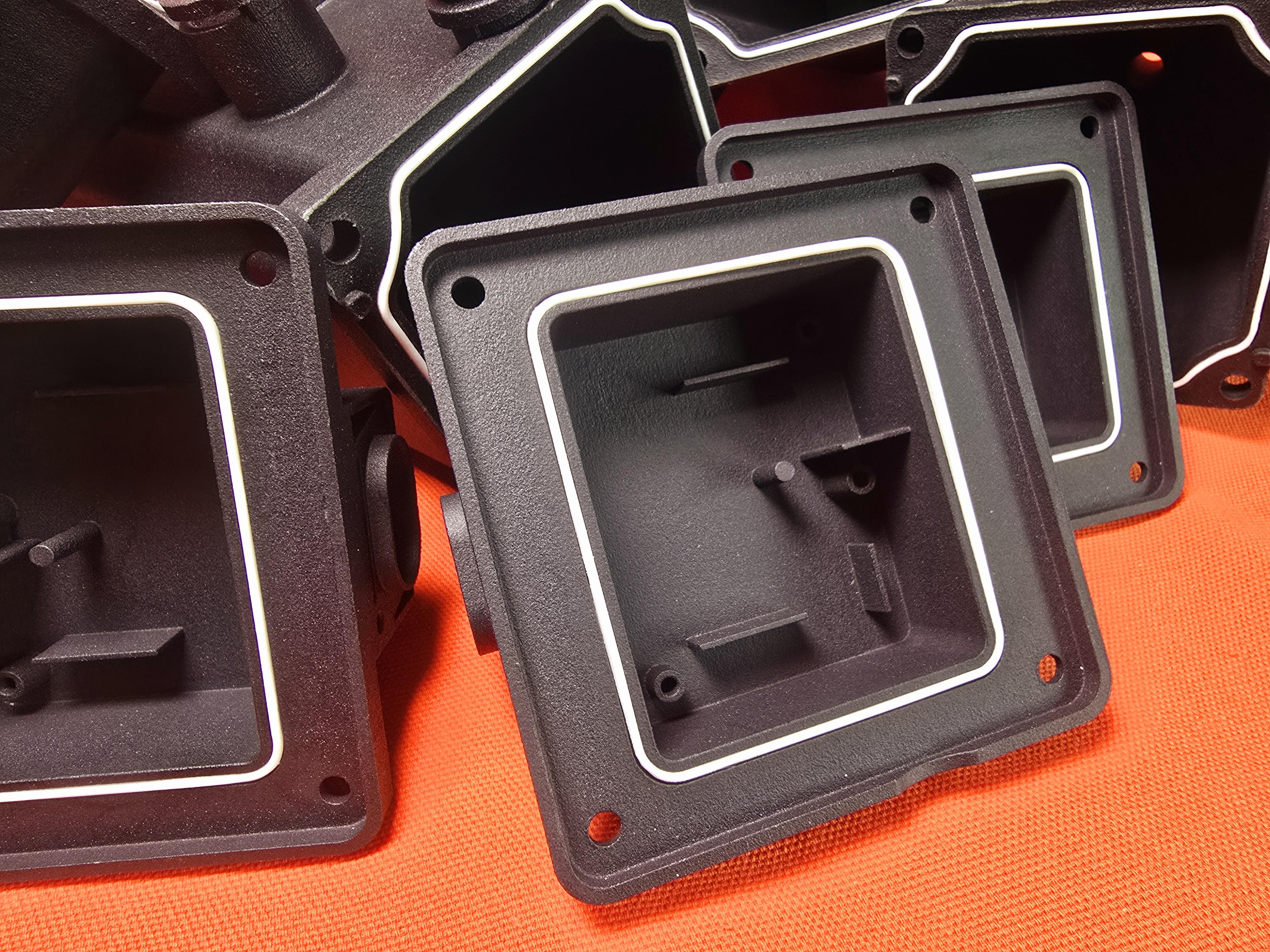
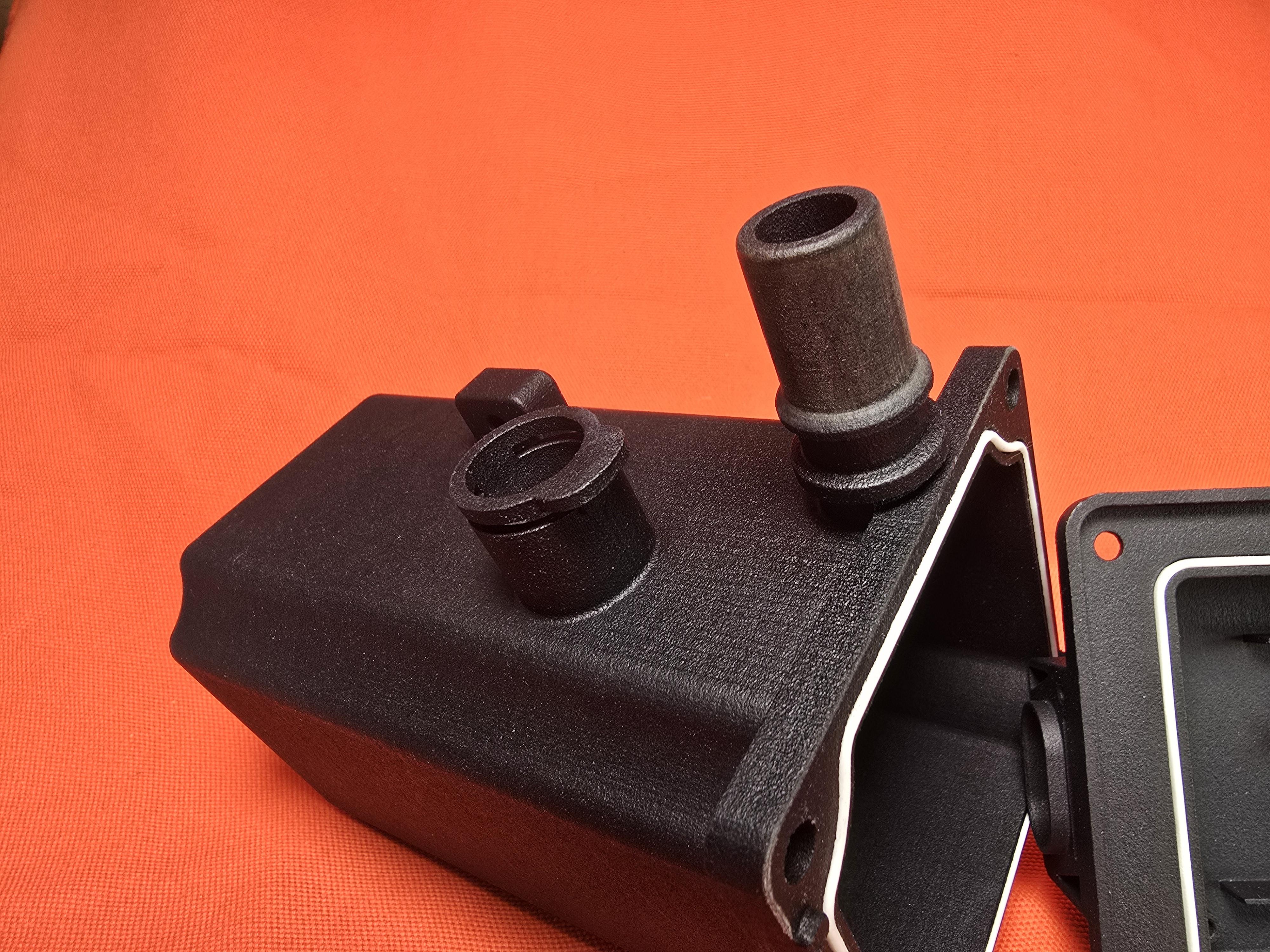
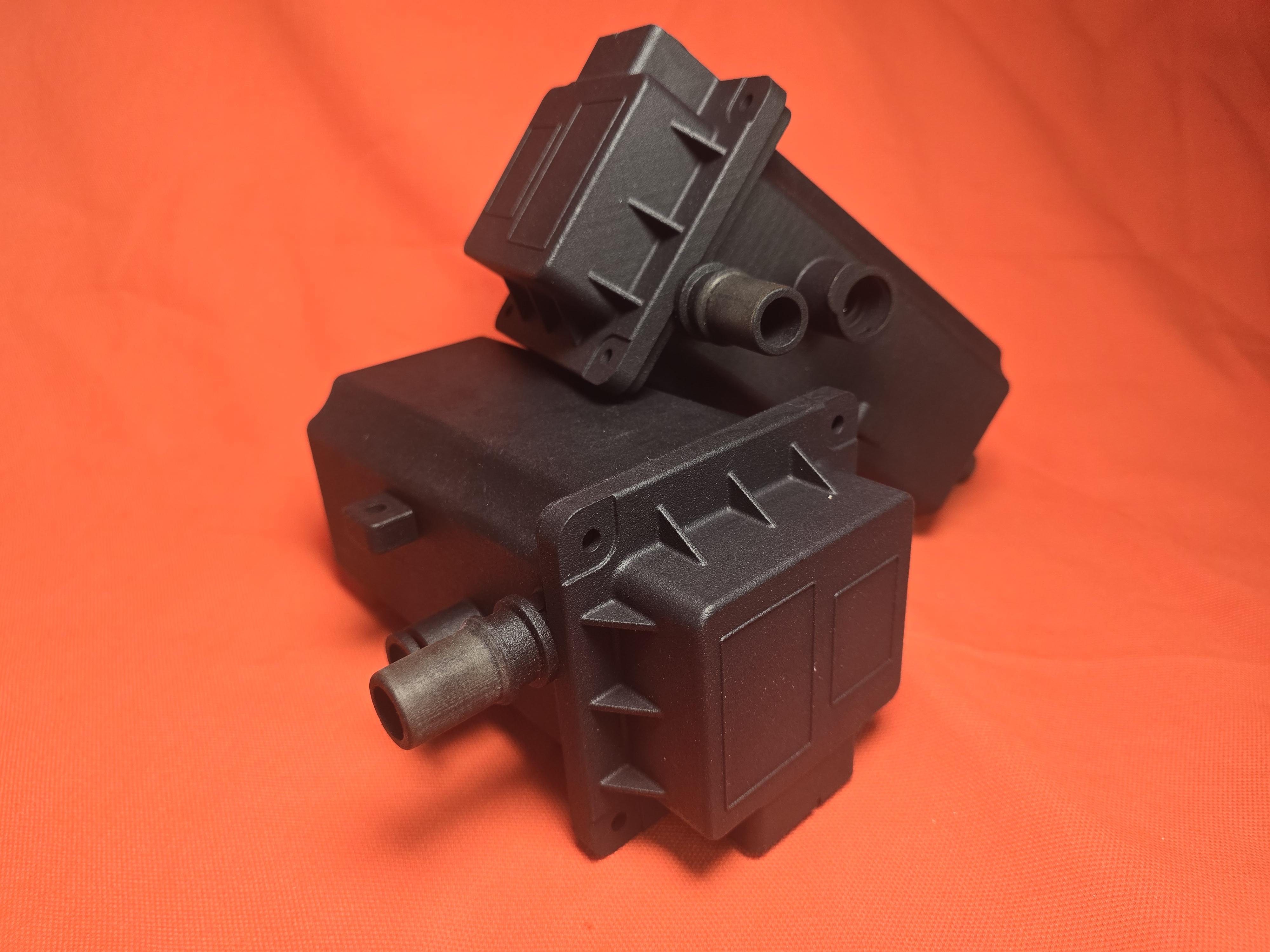
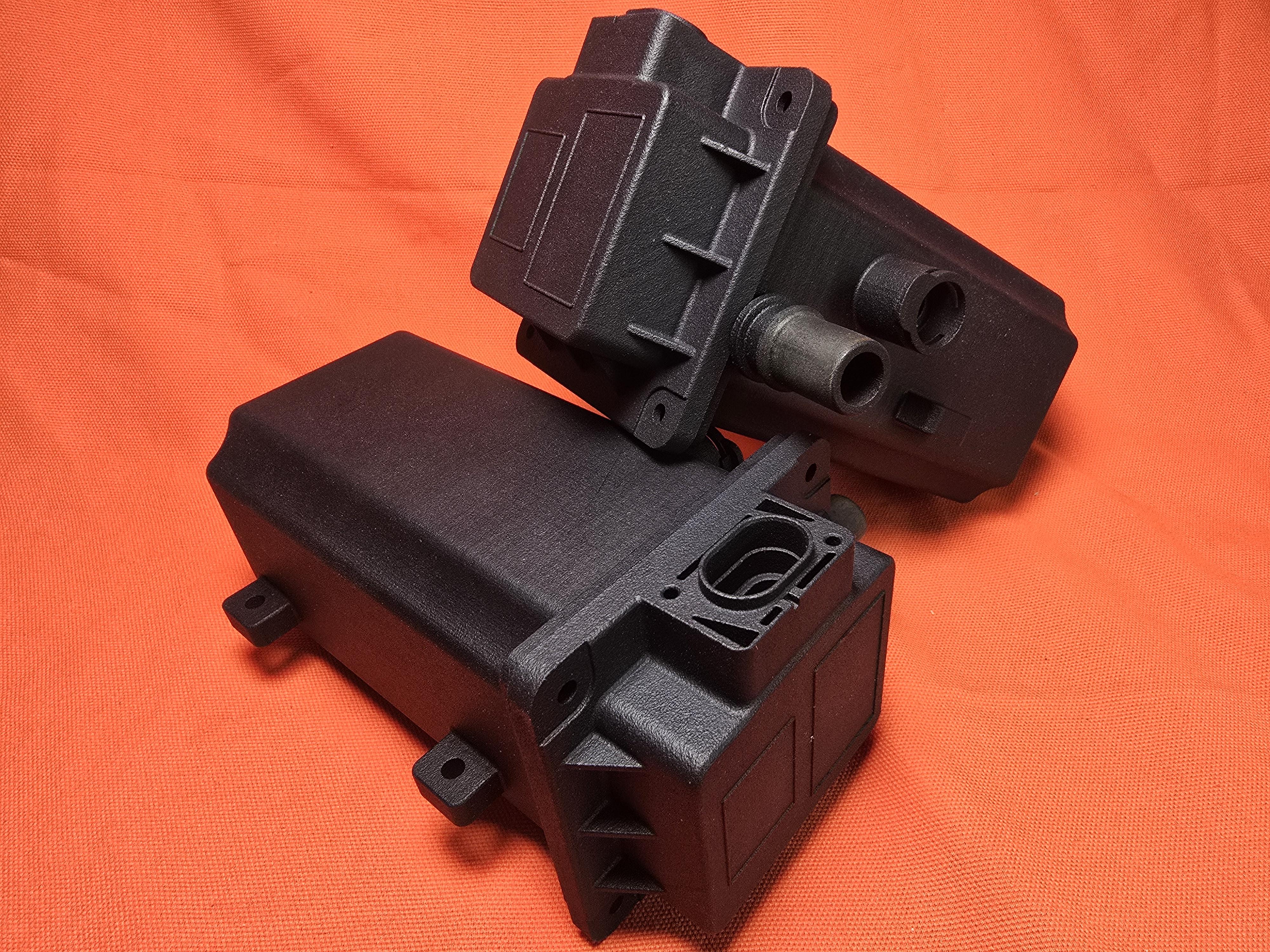
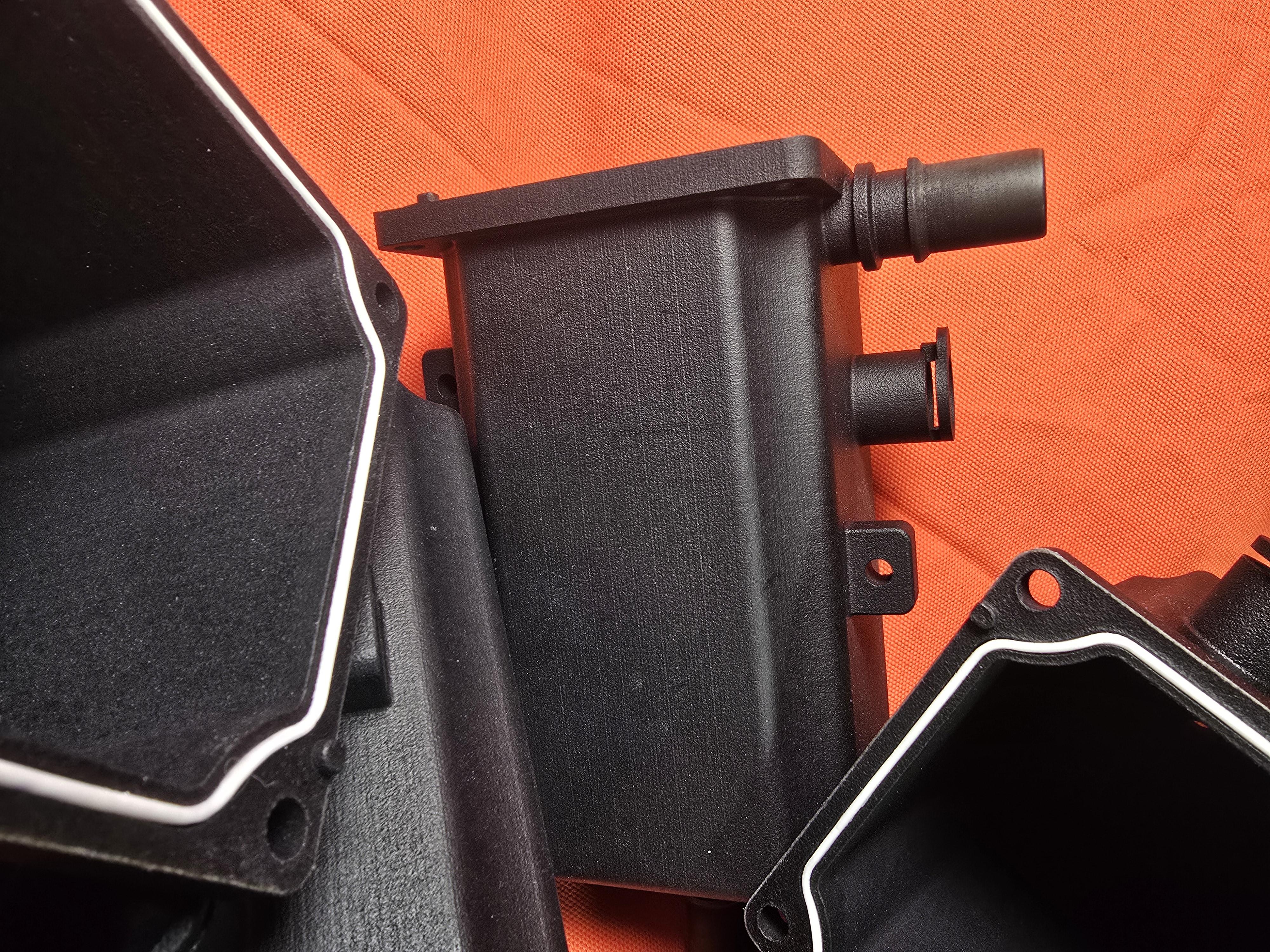
실린더 본체는 MJF 방식으로 출력되었으며, 재질은 PA12를 적용했습니다. PA12는 약 80~100℃ 내외의 온도 환경에서도 형상을 안정적으로 유지할 수 있는 수준의 내열성과, 기밀 구조에 요구되는 재질적 안정성을 함께 고려하여 선정되었습니다. 특히 MJF 방식은 분말 재료 위에 융착제와 디테일링제를 분사한 뒤 적외선으로 순간 가열하여 적층하는 방식으로, 비교적 높은 밀도와 균일한 표면 상태를 확보할 수 있어 기밀성과 조립 정밀도가 중요한 부품 제작에 유리합니다. 또한 충분한 폴리싱 후가공을 통해, 실제 기능성을 전제로 한 매끄러운 밀폐 접촉면을 구현할 수 있다는 점에서도 의미가 있습니다.
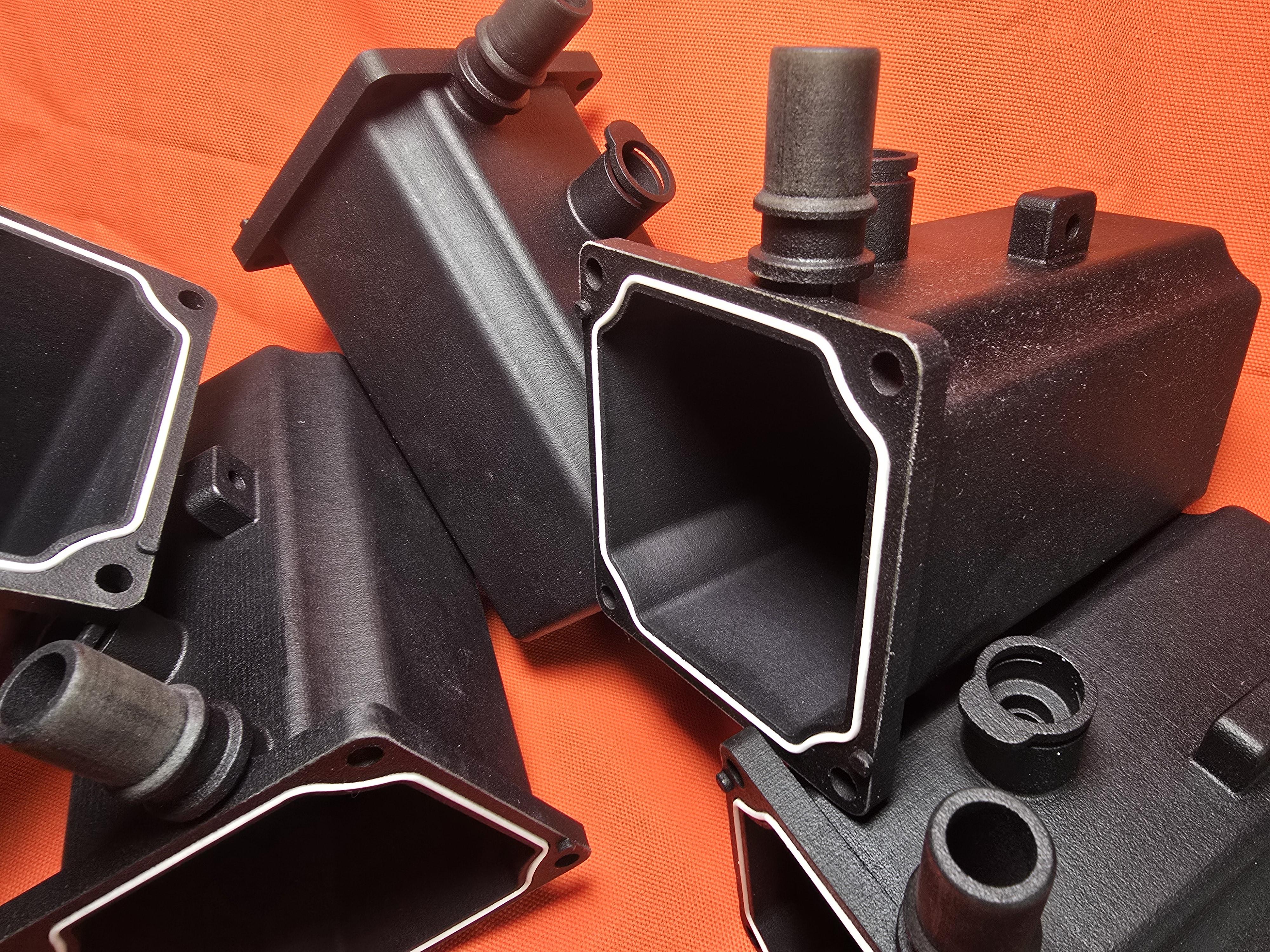
함께 적용된 60A 경도의 실리콘 가스켓은 문스톤 디자인 3D가 발명·상용화한 적층제조 기반 몰드 제작 기술, 즉 특허 「연질 성형물의 성형 몰드(KP 10-2526646)」 를 활용하여 제작되었습니다. 이는 3D 프린팅으로 제작된 본체 부품에 더해, 여기에 결합되는 탄성 실링 부품까지 적층제조 응용 기술로 연계하여 구현한 사례입니다.
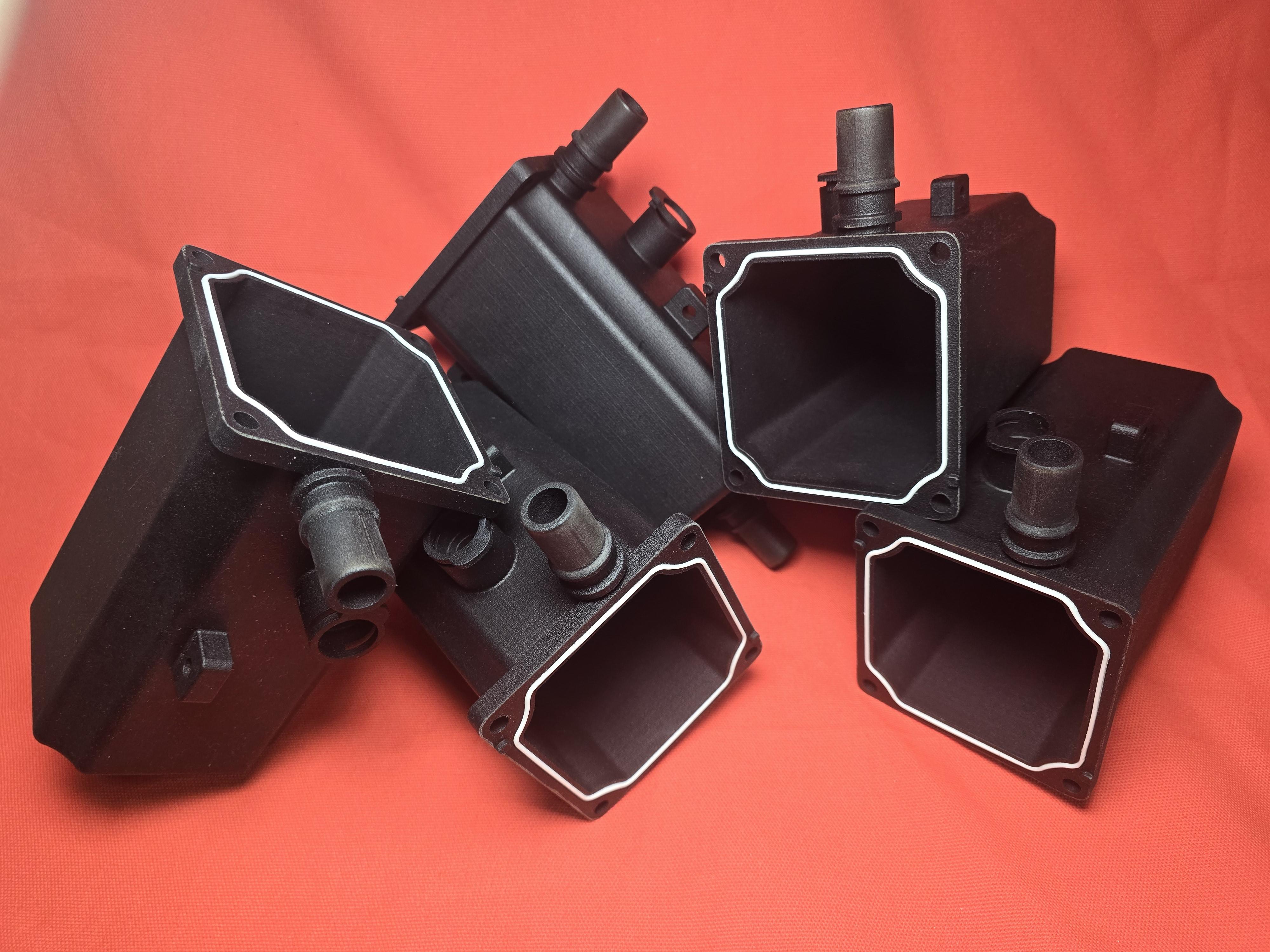
즉, 본 사례는 대우전자를 전신으로 한 국내 주요 제조기업 아진전자가 요구하는 실사용 성능을, MJF 기반 PA12 기밀 실린더와 적층제조 응용 실리콘 가스켓의 조합으로 구현한 사례라 할 수 있습니다. 이는 적층제조가 단순한 시제품 제작을 넘어, 국내 주요 제조기업이 요구하는 기밀성, 내열성, 조립 신뢰성을 갖춘 기능성 부품 제작 수단으로도 충분히 활용될 수 있음을 보여주는 대표 사례입니다.
------------------------------------------------------------------------------------------------------------------------------------
Background
Market interest in manufacturing methods using additive manufacturing grew rapidly throughout the 2010s. There was increasing expectation that additive manufacturing could gradually replace areas that had previously been handled by CNC machining or mold-based production, and with the later emergence of metal printing methods, its possibilities expanded even further. In actual industrial settings, however, material compatibility and quality stability remained major issues, and conventional methods based on direct machining of raw materials continued to maintain strong competitiveness.
Within this context, SLS demonstrated an important possibility for additive manufacturing to expand into the field of functional parts. However, due to its inherently rough surface characteristics, it had clear limitations when applied to industrial components requiring airtightness or precise assembly. Later, with the introduction of MJF, which complemented those limitations, it became possible to secure higher density and a more uniform surface condition, and in recent years its practical use has gradually become more common among major domestic and global manufacturers.
Even so, additive manufacturing remained a field in which equipment costs were high and the accumulation and sharing of practical know-how were still insufficient. In particular, when there was not enough understanding of which printing method suited which purpose, repeated failures or unnecessary costs could easily arise during development and manufacturing. In the end, applying additive manufacturing to real industrial components required more than simply operating the equipment; it demanded engineering capability that could accurately understand the material characteristics and mechanical behavior of each printing method, while also designing post-processing and complementary parts together.
The Ajin Electronic Components case is meaningful precisely in that context. This project solved a challenge presented by Ajin Electronic Components (formerly Daewoo Electronics), one of Korea’s major manufacturing companies, by selecting an appropriate additive manufacturing method according to the required performance and usage environment of the device, and by linking that method with post-processing and silicone auxiliary-part fabrication. In other words, it stands as a record showing that additive manufacturing can be used not only for simple prototyping, but also as a practical means of producing industrial parts with the functionality and assembly reliability required in real manufacturing environments.
Project Features
This is a production case of a cylinder and silicone gasket required to maintain airtightness in a pneumatic environment of 5 bar or higher (approximately 0.5 MPa class).
The work was designed and produced not as a simple shape realization, but as a functional component that had to secure both actual pressure retention performance and assembly reliability at the same time.
The main cylinder body was printed using the MJF process, with PA12 selected as the material. PA12 was chosen in consideration of both the heat resistance required to maintain its form stably in temperature environments of approximately 80–100°C, and the material stability needed for an airtight structure. In particular, the MJF method builds parts by spraying fusing and detailing agents onto powder material and then instantaneously heating it with infrared energy, making it advantageous for producing components where airtightness and assembly precision are important, because it can achieve relatively high density and a uniform surface condition. It is also meaningful in that, through sufficient polishing post-processing, it can realize a smooth sealing contact surface intended for actual functional use.
The accompanying 60A silicone gasket was manufactured using Moonstone Design 3D’s additive-manufacturing-based mold fabrication technology, namely the patented “Mold for Soft Molded Products (KP 10-2526646).” This case demonstrates not only a 3D-printed main body component, but also the realization of the elastic sealing part combined with it through an additive-manufacturing-applied process.
In other words, this case can be understood as one in which the real-use performance required by Ajin Electronic Components, a major Korean manufacturer originating from Daewoo Electronics, was implemented through the combination of an MJF-based PA12 airtight cylinder and an additive-manufacturing-applied silicone gasket. It is a representative example showing that additive manufacturing can be effectively utilized not only for prototyping, but also as a means of producing functional parts that satisfy the airtightness, heat resistance, and assembly reliability required by major domestic manufacturers.
------------------------------------------------------------------------------------------------------------------------------------
Background
積層造形を用いた製品製造方式に対する市場の関心は、2010年代に入って急速に高まりました。従来は CNC 加工や金型製作が担っていた領域を、積層造形が徐々に代替できるのではないかという期待が形成され、その後、金属出力方式まで登場したことで、その可能性はさらに広がりました。しかし実際の産業現場では、素材対応性と品質安定性の問題が依然として大きく、原材料を直接加工する従来方式もなお強い競争力を維持していました。
その中で SLS方式 は、積層造形が機能性部品の領域へ拡張できる重要な可能性を示した技術でした。しかし、その特有の粗い表面特性のために、気密性や精密な組立性が求められる産業用部品へ適用するには明確な限界がありました。その後、それを補完する MJF方式 が登場したことで、より高い密度と均一な表面品質を確保できるようになり、近年では国内外の主要製造企業を中心に実務適用が次第に一般化しつつあります。
それにもかかわらず、積層造形は依然として装置導入コストが高く、実務経験の蓄積と共有も十分ではない分野でした。特に、どの出力方式がどの目的に適しているかについての理解が不足している場合、開発や製造の過程で繰り返し失敗や不要なコストが発生しやすくなります。結局、積層造形を実際の産業部品に適用するためには、単に装置を扱えるだけでなく、各出力方式が持つ材料特性や機構的作用を正確に理解し、さらに後加工や補完部品まで含めて設計できるエンジニアリング能力が必要でした。
Ajin Electronic Components の事例は、まさにその点において意味を持ちます。本作業は、装置が要求する性能と使用環境に応じて適切な積層造形方式を選択し、さらに後加工とシリコン副資材の製作まで連携させることで、韓国の主要製造企業の一つである Ajin Electronic Components(旧・大宇電子) の課題を解決した事例でした。言い換えれば、積層造形が単なる試作品製作を超えて、実際の産業現場で求められる機能性と組立信頼性を備えた部品製作方式として活用できることを示した記録だと言えます。
Project Features
本事例は、5bar以上(約0.5MPa級)の空圧環境 において気密保持が求められるシリンダーおよびシリコンガスケットの製作事例です。
本作業は単なる形状再現ではなく、実際の圧力保持性能と組立信頼性を同時に確保しなければならない機能部品として設計・製作されました。
シリンダー本体は MJF方式 で出力され、材料には PA12 が採用されました。PA12 は、約 80〜100℃ 程度の温度環境でも形状を安定して維持できるレベルの耐熱性と、気密構造に求められる材料安定性の両方を考慮して選定されたものです。特に MJF方式は、粉末材料の上に融着剤とディテーリング剤を噴射した後、赤外線で瞬間加熱して積層する方式であり、比較的高い密度と均一な表面状態を確保できるため、気密性と組立精度が重要な部品製作に有利です。また、十分なポリッシング後加工を行うことで、実際の機能性を前提とした滑らかな密閉接触面を実現できる点でも意義があります。
あわせて適用された 60A硬度のシリコンガスケット は、Moonstone Design 3D が発明・商用化した積層造形ベースのモールド製作技術、すなわち特許 「軟質成形物の成形モールド(KP 10-2526646)」 を活用して製作されました。これは、3Dプリントで製作された本体部品だけでなく、そこに結合される弾性シーリング部品まで積層造形応用技術として連携して実現した事例です。
つまり本事例は、旧・大宇電子を前身とする韓国の主要製造企業 Ajin Electronic Components が求める実使用性能を、MJFベースのPA12気密シリンダー と 積層造形応用シリコンガスケット の組み合わせによって実現した事例だと言えます。これは、積層造形が単なる試作品製作を超え、国内主要製造企業が求める 気密性、耐熱性、組立信頼性 を備えた機能部品製作手段としても十分活用できることを示す代表的な事例です.
------------------------------------------------------------------------------------------------------------------------------------
Detail Images




Background
적층제조를 이용한 제품 제조 방식에 대한 시장의 관심은 2010년대 들어 급속히 커졌습니다. 과거에는 CNC 가공이나 주형 제작이 담당하던 영역을, 적층제조가 점차 대체할 수 있으리라는 기대가 형성되었고, 이후 기술 발전과 함께 금속 출력 방식까지 등장하면서 그 가능성은 더욱 넓어졌습니다. 그러나 실제 산업 현장에서는 여전히 소재 대응성과 품질 안정성의 문제가 크게 작용했고, 원재료를 직접 가공하는 기존 방식 역시 강한 경쟁력을 유지하고 있었습니다.
이 가운데 SLS 방식은 적층제조가 기능성 부품 영역으로 확장될 수 있는 중요한 가능성을 보여준 기술이었습니다. 하지만 특유의 거친 표면 특성으로 인해, 기밀성이나 정밀한 조립성이 요구되는 산업용 부품에 적용하는 데에는 분명한 한계가 있었습니다. 이후 이를 보완한 MJF 방식이 등장하면서, 보다 높은 밀도와 균일한 표면 품질을 확보할 수 있게 되었고, 최근에는 국내외 주요 제조기업을 중심으로 실무 적용이 점차 보편화되고 있습니다.
그럼에도 불구하고 적층제조는 여전히 장비 도입 비용이 높고, 실무 경험의 축적과 공유가 충분하지 않은 영역이었습니다. 특히 어떤 출력 방식이 어떤 목적에 적합한지에 대한 이해가 부족할 경우, 개발과 제조 과정에서 반복적인 실패나 불필요한 비용이 발생하기 쉬웠습니다. 결국 적층제조를 실제 산업 부품에 적용하기 위해서는, 단순히 장비를 다루는 수준을 넘어 각 출력 기법이 지닌 재질적 특성과 기구적 작용을 정확히 이해하고, 후가공과 보완 부품까지 함께 설계할 수 있는 엔지니어링 역량이 필요했습니다.
아진전자 사례는 바로 그런 지점에서 의미를 갖습니다. 본 작업은 장치가 요구하는 성능과 사용 환경에 맞추어 적절한 적층제조 기법을 선택하고, 여기에 후가공과 실리콘 부자재 제작까지 연계하여, 국내 주요 제조기업 중 하나인 아진전자(구 대우전자) 의 과제를 해결한 사례였습니다. 다시 말해, 적층제조가 단순한 시제품 제작을 넘어 실제 산업 현장에서 요구되는 기능성과 조립 신뢰성을 갖춘 부품 제작 방식으로 활용될 수 있음을 보여준 기록이라 할 수 있습니다.
Project Features
5bar 이상(약 0.5MPa급)의 공기압 환경에서 기밀 유지가 요구되는 실린더와 실리콘 가스켓의 제작 사례입니다.
본 작업은 단순한 형상 구현이 아니라, 실제 압력 유지 성능과 조립 신뢰성을 동시에 확보해야 하는 기능성 부품으로서 설계 및 제작되었습니다.
실린더 본체는 MJF 방식으로 출력되었으며, 재질은 PA12를 적용했습니다. PA12는 약 80~100℃ 내외의 온도 환경에서도 형상을 안정적으로 유지할 수 있는 수준의 내열성과, 기밀 구조에 요구되는 재질적 안정성을 함께 고려하여 선정되었습니다. 특히 MJF 방식은 분말 재료 위에 융착제와 디테일링제를 분사한 뒤 적외선으로 순간 가열하여 적층하는 방식으로, 비교적 높은 밀도와 균일한 표면 상태를 확보할 수 있어 기밀성과 조립 정밀도가 중요한 부품 제작에 유리합니다. 또한 충분한 폴리싱 후가공을 통해, 실제 기능성을 전제로 한 매끄러운 밀폐 접촉면을 구현할 수 있다는 점에서도 의미가 있습니다.
함께 적용된 60A 경도의 실리콘 가스켓은 문스톤 디자인 3D가 발명·상용화한 적층제조 기반 몰드 제작 기술, 즉 특허 「연질 성형물의 성형 몰드(KP 10-2526646)」 를 활용하여 제작되었습니다. 이는 3D 프린팅으로 제작된 본체 부품에 더해, 여기에 결합되는 탄성 실링 부품까지 적층제조 응용 기술로 연계하여 구현한 사례입니다.
즉, 본 사례는 대우전자를 전신으로 한 국내 주요 제조기업 아진전자가 요구하는 실사용 성능을, MJF 기반 PA12 기밀 실린더와 적층제조 응용 실리콘 가스켓의 조합으로 구현한 사례라 할 수 있습니다. 이는 적층제조가 단순한 시제품 제작을 넘어, 국내 주요 제조기업이 요구하는 기밀성, 내열성, 조립 신뢰성을 갖춘 기능성 부품 제작 수단으로도 충분히 활용될 수 있음을 보여주는 대표 사례입니다.
------------------------------------------------------------------------------------------------------------------------------------
Background
Market interest in manufacturing methods using additive manufacturing grew rapidly throughout the 2010s. There was increasing expectation that additive manufacturing could gradually replace areas that had previously been handled by CNC machining or mold-based production, and with the later emergence of metal printing methods, its possibilities expanded even further. In actual industrial settings, however, material compatibility and quality stability remained major issues, and conventional methods based on direct machining of raw materials continued to maintain strong competitiveness.
Within this context, SLS demonstrated an important possibility for additive manufacturing to expand into the field of functional parts. However, due to its inherently rough surface characteristics, it had clear limitations when applied to industrial components requiring airtightness or precise assembly. Later, with the introduction of MJF, which complemented those limitations, it became possible to secure higher density and a more uniform surface condition, and in recent years its practical use has gradually become more common among major domestic and global manufacturers.
Even so, additive manufacturing remained a field in which equipment costs were high and the accumulation and sharing of practical know-how were still insufficient. In particular, when there was not enough understanding of which printing method suited which purpose, repeated failures or unnecessary costs could easily arise during development and manufacturing. In the end, applying additive manufacturing to real industrial components required more than simply operating the equipment; it demanded engineering capability that could accurately understand the material characteristics and mechanical behavior of each printing method, while also designing post-processing and complementary parts together.
The Ajin Electronic Components case is meaningful precisely in that context. This project solved a challenge presented by Ajin Electronic Components (formerly Daewoo Electronics), one of Korea’s major manufacturing companies, by selecting an appropriate additive manufacturing method according to the required performance and usage environment of the device, and by linking that method with post-processing and silicone auxiliary-part fabrication. In other words, it stands as a record showing that additive manufacturing can be used not only for simple prototyping, but also as a practical means of producing industrial parts with the functionality and assembly reliability required in real manufacturing environments.
Project Features
This is a production case of a cylinder and silicone gasket required to maintain airtightness in a pneumatic environment of 5 bar or higher (approximately 0.5 MPa class).
The work was designed and produced not as a simple shape realization, but as a functional component that had to secure both actual pressure retention performance and assembly reliability at the same time.
The main cylinder body was printed using the MJF process, with PA12 selected as the material. PA12 was chosen in consideration of both the heat resistance required to maintain its form stably in temperature environments of approximately 80–100°C, and the material stability needed for an airtight structure. In particular, the MJF method builds parts by spraying fusing and detailing agents onto powder material and then instantaneously heating it with infrared energy, making it advantageous for producing components where airtightness and assembly precision are important, because it can achieve relatively high density and a uniform surface condition. It is also meaningful in that, through sufficient polishing post-processing, it can realize a smooth sealing contact surface intended for actual functional use.
The accompanying 60A silicone gasket was manufactured using Moonstone Design 3D’s additive-manufacturing-based mold fabrication technology, namely the patented “Mold for Soft Molded Products (KP 10-2526646).” This case demonstrates not only a 3D-printed main body component, but also the realization of the elastic sealing part combined with it through an additive-manufacturing-applied process.
In other words, this case can be understood as one in which the real-use performance required by Ajin Electronic Components, a major Korean manufacturer originating from Daewoo Electronics, was implemented through the combination of an MJF-based PA12 airtight cylinder and an additive-manufacturing-applied silicone gasket. It is a representative example showing that additive manufacturing can be effectively utilized not only for prototyping, but also as a means of producing functional parts that satisfy the airtightness, heat resistance, and assembly reliability required by major domestic manufacturers.
------------------------------------------------------------------------------------------------------------------------------------
Background
積層造形を用いた製品製造方式に対する市場の関心は、2010年代に入って急速に高まりました。従来は CNC 加工や金型製作が担っていた領域を、積層造形が徐々に代替できるのではないかという期待が形成され、その後、金属出力方式まで登場したことで、その可能性はさらに広がりました。しかし実際の産業現場では、素材対応性と品質安定性の問題が依然として大きく、原材料を直接加工する従来方式もなお強い競争力を維持していました。
その中で SLS方式 は、積層造形が機能性部品の領域へ拡張できる重要な可能性を示した技術でした。しかし、その特有の粗い表面特性のために、気密性や精密な組立性が求められる産業用部品へ適用するには明確な限界がありました。その後、それを補完する MJF方式 が登場したことで、より高い密度と均一な表面品質を確保できるようになり、近年では国内外の主要製造企業を中心に実務適用が次第に一般化しつつあります。
それにもかかわらず、積層造形は依然として装置導入コストが高く、実務経験の蓄積と共有も十分ではない分野でした。特に、どの出力方式がどの目的に適しているかについての理解が不足している場合、開発や製造の過程で繰り返し失敗や不要なコストが発生しやすくなります。結局、積層造形を実際の産業部品に適用するためには、単に装置を扱えるだけでなく、各出力方式が持つ材料特性や機構的作用を正確に理解し、さらに後加工や補完部品まで含めて設計できるエンジニアリング能力が必要でした。
Ajin Electronic Components の事例は、まさにその点において意味を持ちます。本作業は、装置が要求する性能と使用環境に応じて適切な積層造形方式を選択し、さらに後加工とシリコン副資材の製作まで連携させることで、韓国の主要製造企業の一つである Ajin Electronic Components(旧・大宇電子) の課題を解決した事例でした。言い換えれば、積層造形が単なる試作品製作を超えて、実際の産業現場で求められる機能性と組立信頼性を備えた部品製作方式として活用できることを示した記録だと言えます。
Project Features
本事例は、5bar以上(約0.5MPa級)の空圧環境 において気密保持が求められるシリンダーおよびシリコンガスケットの製作事例です。
本作業は単なる形状再現ではなく、実際の圧力保持性能と組立信頼性を同時に確保しなければならない機能部品として設計・製作されました。
シリンダー本体は MJF方式 で出力され、材料には PA12 が採用されました。PA12 は、約 80〜100℃ 程度の温度環境でも形状を安定して維持できるレベルの耐熱性と、気密構造に求められる材料安定性の両方を考慮して選定されたものです。特に MJF方式は、粉末材料の上に融着剤とディテーリング剤を噴射した後、赤外線で瞬間加熱して積層する方式であり、比較的高い密度と均一な表面状態を確保できるため、気密性と組立精度が重要な部品製作に有利です。また、十分なポリッシング後加工を行うことで、実際の機能性を前提とした滑らかな密閉接触面を実現できる点でも意義があります。
あわせて適用された 60A硬度のシリコンガスケット は、Moonstone Design 3D が発明・商用化した積層造形ベースのモールド製作技術、すなわち特許 「軟質成形物の成形モールド(KP 10-2526646)」 を活用して製作されました。これは、3Dプリントで製作された本体部品だけでなく、そこに結合される弾性シーリング部品まで積層造形応用技術として連携して実現した事例です。
つまり本事例は、旧・大宇電子を前身とする韓国の主要製造企業 Ajin Electronic Components が求める実使用性能を、MJFベースのPA12気密シリンダー と 積層造形応用シリコンガスケット の組み合わせによって実現した事例だと言えます。これは、積層造形が単なる試作品製作を超え、国内主要製造企業が求める 気密性、耐熱性、組立信頼性 を備えた機能部品製作手段としても十分活用できることを示す代表的な事例です.
------------------------------------------------------------------------------------------------------------------------------------
Detail Images